
Becoming an OBM
VA vs Project Manager vs OBM: The Real Difference (and Which One You Are Now)

Annikka AborroPublished Oct 13, 2026 · 9 min read

Short answer
A VA owns the task, a project manager owns the plan, and an OBM owns the result. You can tell which one you are by the question you answer most. "What does done look like?" is VA work. "Who does what, by when?" is PM work. "What result are we protecting, and what do I recommend?" is OBM work.
Free OBM Readiness Scorecard
A few minutes, a personalized result, and a clear next skill to practice.
Take the ScorecardThe title on your contract tells you almost nothing about the work you actually do.
I've seen VAs running entire launches and "OBMs" who mostly forward messages. So when people ask me about VA vs project manager vs OBM, I don't start with job descriptions. I start with one thing: what question are you paid to answer?
If you need the basic definition of the role first, read What Is an Online Business Manager? on our site. This post goes one step further. It shows you how to spot the difference in your own inbox this week.
VA vs project manager vs OBM: what is the real difference?
The real difference is the question each role is responsible for answering. The tasks can look the same from the outside. The thinking behind them doesn't.
These are the three questions I teach in the Philippine OBM Academy. I call them the useful questions, because they cut through titles fast:
- VA: What needs to be completed, and what does done look like?
- Project manager: What needs to happen, in what order, by whom, and by when?
- OBM: What result are we protecting, what is blocking it, and what do I recommend next?
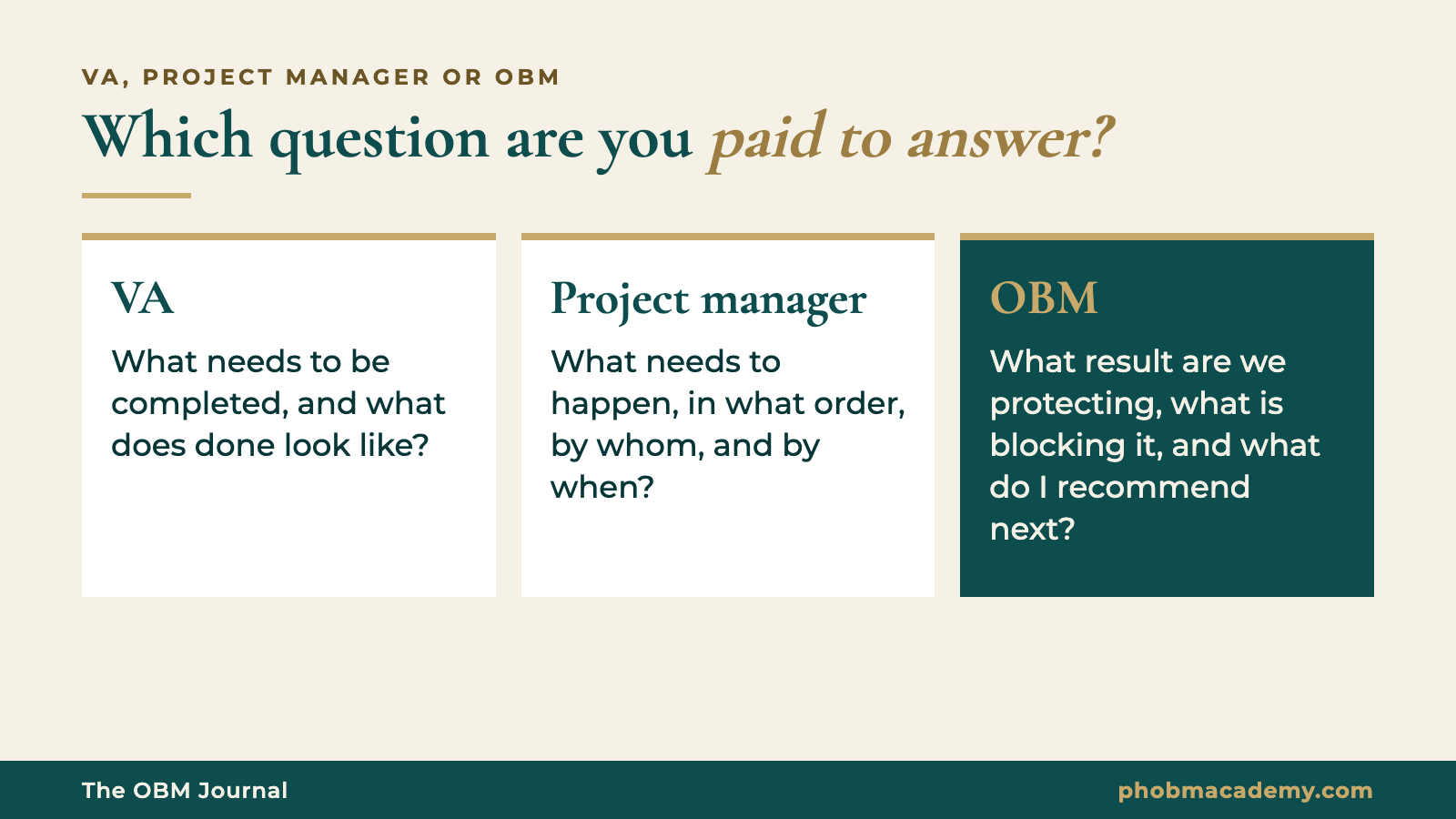
Here's how that plays out across a normal week of client work.
| Virtual Assistant (VA) | Project Manager (PM) | Online Business Manager (OBM) | |
|---|---|---|---|
| The question you answer | What does done look like? | Who does what, by when? | What result are we protecting, and what do I recommend? |
| What you're handed | A task | A project with a goal and a deadline | A business result that keeps slipping |
| What you hand back | The finished task | A plan, a timeline and updates | A recommendation, an owner and a way to measure it |
| What "done" means | The task is complete and correct | The project shipped on time | The result improved and stays improved |
| Who decides what matters | The client | The client, with your plan | The client, based on your recommendation |
| When something breaks | You flag it | You re-plan around it | You find the real cause and propose the fix |
Notice the last two rows. An OBM doesn't take decisions away from the founder. She makes sure the founder is deciding with clarity, options and a recommendation, instead of guessing.
What does each role look like with the same client message?
The fastest way to see the difference is to give all three roles the same message. Here's a made-up example. Say your client runs an online coaching program, and this lands in Slack on a Monday:
"hey! enrollment opens in 2 weeks and the welcome emails are a mess 😩 can you fix them?"
The VA reply:
"On it! I'll rewrite the welcome emails and send them to you for review by Thursday 🙂"
The PM reply:
"Got it. Plan: I draft the copy by Tuesday, the designer checks the layout Wednesday, I load and test Thursday, and it goes live Friday. I'll tell you right away if anything slips."
The OBM reply:
"Before I touch the emails, quick check. Most of this week's support messages from new students are about logging in, not about the emails. I recommend we fix the login step first, then rewrite the emails. If you agree, I'll own the whole welcome flow until enrollment closes, and we'll know it's working when the login questions stop. Can I get your yes by Wednesday?"
None of these replies is wrong. A good VA reply is fast and reliable. A good PM reply is organized. But only the third one asks whether the request will actually fix the problem.
That's the part people miss. The OBM doesn't skip the VA work or the PM work. She decides which work is worth doing first, and she says so out loud.
Is an OBM just a senior VA or a project manager with a new title?
No. An OBM isn't a VA with more tasks, and she isn't a project manager with a fancier title. The difference is what she's responsible for.
A project has an end. The Project Management Institute's PMBOK Guide describes a project as a temporary activity that creates a unique result, as quoted in the open textbook Project Management from Simple to Complex. A launch, a migration, a website rebuild. You plan it, you run it, it closes.
An OBM looks after the operations that keep running after the project closes. Onboarding, client care, weekly reporting, team follow-up. The work never "ships." It just keeps working, or it doesn't.
The OBM title itself grew out of VA work. Tina Forsyth, who wrote Becoming an Online Business Manager, wrote it to help train VAs for more advanced roles in running a business, according to this Duct Tape Marketing interview page. So yes, many OBMs start as VAs. But the step up is responsibility, not volume.
One more thing worth saying. An OBM isn't the person who invents the offer or the sales strategy. A US business coach made that point on Threads earlier this year: an OBM can implement pieces of those things, but usually isn't the one deciding what gets built (Threads, April 2026). I agree. The way I teach it, the OBM protects the result and recommends. The founder decides.
Why do job posts mix up VA, project manager and OBM?
Job posts mix them up because many founders don't know the difference yet. They write the title they've heard, then list the work they need.
Search "online business manager" on OnlineJobs.ph right now and the recent titles include "Executive Assistant / Online Business Manager," "Remote Operations Manager / Integrator" and "Online Business Manager & Team Lead" (search results). Same search, very different jobs.
Read the verbs and you can tell them apart:
- The Executive Assistant / Online Business Manager post (updated August 2026) asks for someone to "Prep my day and my week" and follow up with the team "without me chasing." That's strong EA and PM work. The decisions stay with the owner.
- The Online Business Manager & Team Lead post (updated September 2026) asks for 1:1s with every team member, weekly check-ins, a weekly report on what needs the founder's decision, and "the judgment to review" AI output. That one is OBM work.
So don't trust the title on the post, and don't trust the title on your contract either. Trust the verbs.
Which one are you right now?
You can find out in about 15 minutes. Look at what you were actually asked to do, not what your contract says.
- Open your client messages from the last two weeks and pick 20 requests.
- Next to each one, write which question you answered: "done," "who and when," or "result and recommendation."
- Count how many land in each group.
- For the "result and recommendation" group, check one more thing: did you actually recommend something, or did you hand the problem back with "let me know what you want to do"?
- Circle the group with the most requests.
If most of your list says "done," you're doing VA work right now. That's not a bad thing. Reliable execution is the base everything else stands on.
If most of it says "who and when," you're doing project management, even if nobody calls it that.
If you keep landing in "result and recommendation," you may already be doing OBM work. If that's you, read 7 signs you're already doing OBM work at VA pay next. It covers what to do when your work has grown and your role hasn't.
Which OBM skills does each role use?
Every role uses some of the same skills. The OBM is the one expected to use all of them at once.
I teach OBM work as 7 skill areas:
- Understanding the business
- Finding the real problem
- Making recommendations
- Planning and follow-through
- Leading people
- Showing results
- Defining the work (scope)
A strong VA lives mostly in planning and follow-through, at the task level. A strong PM adds leading people and showing results inside a project. An OBM is expected to cover all seven across the whole operation, and the three that usually separate her from the other two are finding the real problem, making recommendations and defining the work.
For a closer look at each area, with a self-check, read the 7 skills an OBM needs. For an honest read on where you stand, take the free OBM Readiness Scorecard. It takes a few minutes.
Is one role better than the others?
No. These are different jobs, not ranks in a ladder where everyone below the top is failing.
In my 18 years of working online, I've done all three kinds of work, often for the same client. I started as a VA. Over time my clients relied on me for more: organizing projects, coordinating contractors, following up with the team, recommending what should happen next. When I found the OBM role, the work felt familiar. What I had to learn was how to define it, structure it, price it and lead it.
Here's a line from my Launchpad material that I still believe: "Calling yourself an OBM does not justify a higher price. Carrying wider responsibility, making sound recommendations, and helping the business produce better results does."
So the goal isn't to escape the VA title. The goal is to know which work you're doing, do it well, and make sure your role, your boundaries and your pay match it. If you're ready to plan that move, my realistic path is here: How to go from VA to OBM in the Philippines.
FAQ
What is the difference between a VA and an OBM?
A VA is responsible for completing tasks well and on time. An OBM is responsible for a business result, like onboarding that works or a launch that runs smoothly. She finds what's blocking that result, recommends what to do next, and takes ownership of the fix once the client agrees. Many OBMs start as VAs, but the step up is responsibility, not more tasks.
Is an online business manager the same as a project manager?
Not quite. A project manager runs a project with a clear start and end, like a launch or a migration, and makes sure the right people do the right things on time. An OBM looks after the ongoing operations that keep running after projects close. An OBM uses project management skills all the time, but she's also expected to find the real problem and recommend priorities.
Can a VA do OBM work?
Yes, and many experienced VAs already do parts of it without the title. If clients ask what you think they should do, if you run the meetings, or if you make sure other people deliver, you're doing OBM-type work. The question is whether your role, authority, boundaries and pay have been agreed to match it. Doing it quietly for free isn't the same as being an OBM.
Why do job posts use VA, PM and OBM interchangeably?
Many founders hire before they know the difference, so they use the title they've heard and then list the work they need. That's why you'll see posts titled "Executive Assistant / Online Business Manager" that are mostly scheduling and follow-up. Read the responsibilities, not the title. Look for words like own, decide, report, lead and recommend.
How do I know which role I'm doing right now?
Take 20 requests from the last two weeks and label each by the question you answered: what does done look like, who does what by when, or what result are we protecting and what do I recommend. The group with the most requests is the role you're mostly doing now. Then check whether you actually gave recommendations or handed problems back.
What to do next
Start with the honest picture. Take the free OBM Readiness Scorecard to see which OBM skill areas you already use and which one to build first.
Want to talk this through with people doing the same work? Join our free community, the Philippine OBM Academy group on Facebook. And if you're already doing OBM-level work and want structured practice with feedback, have a look at OBM Pros, which starts December 2026.