
Becoming an OBM
7 Signs You're Already Doing OBM Work at VA Pay

Annikka AborroPublished Oct 13, 2026 · 9 min read

Short answer
The clearest signs you're already doing OBM work are these: you're in the leadership meetings, you make sure other people deliver, everyone waits for your fix when things break, you run the meetings, clients ask what you recommend, you report on results, and your job description stopped matching your work. The next step is an agreement, not more hours.
Free OBM Readiness Scorecard
A few minutes, a personalized result, and a clear next skill to practice.
Take the ScorecardBeing called "the reliable one" isn't a compliment if your role, authority and pay still say "assistant."
I know, because I was that person. In my 18 years of working online, the moment it finally clicked for me wasn't a course or a job post. It was looking at my own week and realizing I was already doing manager work. At VA pay.
So here are the signs you're already doing OBM work, the ones I saw in myself first. Count how many are true for you this month, not "sometimes, years ago."
What did OBM work look like before I had the title?
It looked like a normal VA job that kept growing. I was already invited to leadership meetings. I was managing people, making sure they did what they were supposed to do. Whenever something went wrong, I was the one proposing a solution. And I was leading all the meetings.
None of that was in my original role. My responsibilities grew long before my title, pricing, authority and boundaries did.
Here's how I describe it now: "I had become extremely valuable to my clients, but I had not learned how to turn that value into authority, boundaries, and a sustainable service."
If that sentence stings a little, keep reading.
What are the signs you're already doing OBM work?
The signs are about responsibility, not task count. Each one below matches one of the 7 OBM skill areas I teach: understanding the business, finding the real problem, making recommendations, planning and follow-through, leading people, showing results, and defining the work.
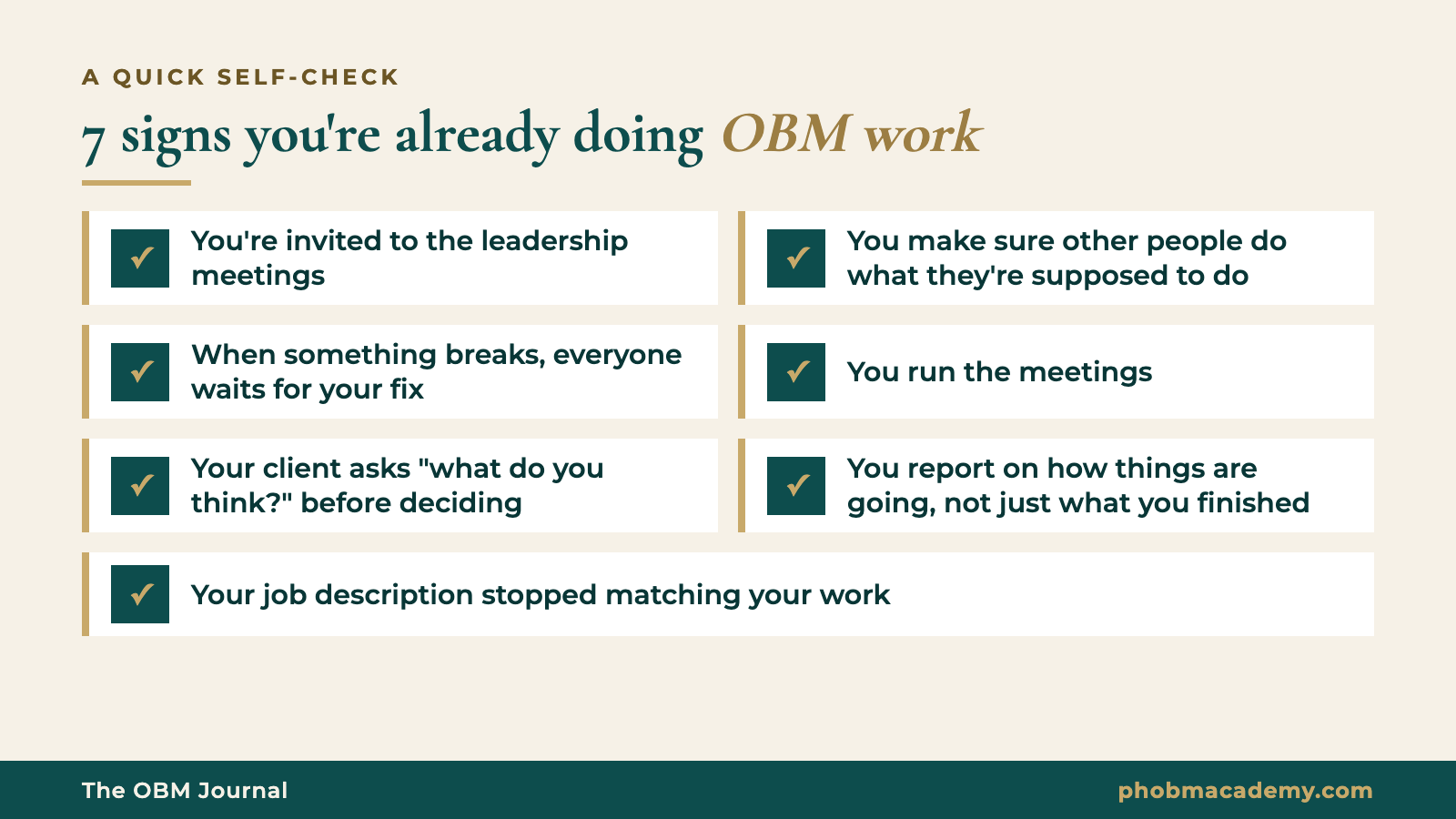
1. You're invited to the leadership meetings
The message looks like this:
"can you join the Monday leadership call? want you there for the ops side of things 🙏"
You're not there to take notes. You're there because you know how things actually run. That's understanding the business, the first OBM skill area. A VA gets told the outcome of the meeting. You're in the room where it's decided.
2. You make sure other people do what they're supposed to do
"can you check if the designer sent the files? and nudge the editor too pls"
Following up once is VA work. Being the person the whole team answers to is leading people. Look at how clients write OBM job posts. One recent OBM and team lead post on OnlineJobs.ph lists regular 1:1s with every team member and weekly check-ins that set priorities and follow up (OnlineJobs.ph, September 2026). If you already do that informally, you're doing the job described there.
3. When something breaks, everyone waits for your fix
"the checkout page is down again 😭 what do we do??"
Notice the question. Not "can you fix it," but "what do we do." When the team waits for you to propose the solution, you're doing finding the real problem and making recommendations. That's the core of OBM work: what result are we protecting, what is blocking it, and what do I recommend next?
4. You run the meetings
You write the agenda, keep people on track, capture the decisions and chase the to-dos afterward. Clients who know what they're hiring put this in writing. A recent remote operations manager post lists running the weekly team meeting, with the agenda, issues list and to-dos, as part of the job (OnlineJobs.ph, September 2026).
That's planning and follow-through at the level of the whole team, not just your own task list.
5. Your client asks "what do you think?" before deciding
"before I say yes to this, what do you think? would this mess up the launch?"
When a founder checks with you before deciding, she trusts your judgment. That's making recommendations. The difference between a VA and an OBM here is simple: does your answer end with "up to you!" or with "I recommend this, and here's why"?
6. You report on how things are going, not just what you finished
A VA update says what got done. An OBM update says where the result stands, what's blocking it, and what the client needs to decide. The same OBM and team lead post asks for a weekly report on team health, progress and the items that need the founder's decision (OnlineJobs.ph).
If you already send that kind of update, you're doing showing results. If you don't yet, my UPWARD update structure (Update, Problem, Ways forward, Advice, Required decision, Deadline) is the way I teach it.
7. Your job description stopped matching your work, and nobody had the conversation
This is the one that hurts, and it's the most common. You were hired for one thing. Now you're doing three. Nobody sat down and agreed what changed.
You can see it on Reddit right now. One VA wrote that their tasks had moved so far from the role they were hired for that the work no longer matched it (Reddit, Oct 1, 2026). Another described being promoted into far more responsibility for a raise so small it felt like "a slap in the face" (Reddit, Oct 12, 2026). These are individual stories, not proof that every client does this. But they're very familiar.
This sign is defining the work (scope), and it's usually the skill area that's missing. It was missing for me too.
Is this OBM work or just extra VA tasks?
It's OBM work when you're responsible for a result, other people's output, or a recommendation. It's extra VA tasks when the list got longer but you're still only answering "what does done look like?"
A quick test: if you went on leave for a week, what would stop? If the answer is "my tasks," that's a busy VA. If the answer is "the meetings, the follow-up, and nobody would know what to fix first," that's OBM work. For a fuller comparison, read VA vs project manager vs OBM.
Why does it matter if nobody calls it OBM work?
It matters because work that isn't named doesn't get agreed, protected or paid for. It just keeps growing.
Here's a line from my Launchpad material: "An OBM is not paid to be the busiest person in the business. An OBM is paid to turn chaos into clarity." If you're doing the clarity work without the agreement, you get the busy part and none of the rest.
There's a second cost people don't talk about. When the role isn't defined, you can't say no to anything, because nothing is officially outside your job.
What should you do if four or more signs fit you?
Don't announce a new title and don't quietly work harder. Get it named, then get it agreed.
- Write down the evidence. For each sign that fits, write one real example from the last 30 days. "Ran the Monday call and followed up on 6 to-dos" counts.
- Pick one result to own. Choose one contained result, like onboarding, weekly team accountability, or one project that keeps slipping. Don't try to formalize everything at once.
- Use the boundary rule. Agree the result, scope, authority, time and compensation before you expand the role. Never act like an OBM for free until someone notices.
- Have the conversation, in writing first. See the message below.
- Turn it into proof. When the result moves, write a Proof Story: what was happening, what you noticed, what you recommended, what you took responsibility for, what changed, and what you learned.
Here's the kind of message you'd actually send:
"Hi Mark! Can we grab 20 minutes this week? Over the last few months I've taken on running the Monday call, following up with the team, and fixing things when they break. I'd love to make that official: agree what I own, what I can decide on my own, how many hours it takes, and how my rate reflects it. I've put a short list of what I've been covering in the doc so we have something concrete to look at 🙂"
If you want the full path, read how to go from VA to OBM in the Philippines.
Should you ask for a raise if you're doing OBM work?
You should ask for an agreement, and pay is part of that agreement. But don't lead with the title, and don't lead with a number pulled from the internet.
Price follows the problem you solve, the scope, the decisions you carry, the people you lead, the proof you can show and the responsibility you take. Not the title. I explain how that works, with no rate ranges on purpose, in how OBM pricing actually works for Filipino OBMs.
What if my client says no?
Then you have real information, and that's useful too. A no tells you what this client is willing to pay for right now.
You have three honest options. Keep the bigger work and agree a clear scope so it stops growing. Hand the extra work back so your role matches your pay again. Or use your Proof Story to find a client who wants the bigger role. None of these is failure. Staying in the unnamed middle forever is the real cost.
FAQ
How do I know if I'm doing OBM work as a VA?
Look at responsibility, not task volume. If you're in leadership meetings, making sure other people deliver, proposing fixes when things break, running the meetings, giving recommendations, or reporting on results, you're doing OBM-type work. If four or more of those are true this month, it's time to get the role named and agreed with your client.
What's the difference between OBM work and extra VA tasks?
Extra VA tasks make your list longer, but you're still answering "what does done look like?" OBM work makes you responsible for a result, for other people's output, or for a recommendation. A simple test: if you took a week off, would your tasks pause, or would the meetings, the follow-up and the problem solving stop too? The second one is OBM work.
Should I ask for a raise if I'm doing OBM work?
Ask for an agreement that includes pay, not just a raise. Agree the result you own, the scope, what you can decide, the time it takes and how your compensation reflects it. Pay for OBM work follows the problem, scope, decisions, people, proof and responsibility involved, so bring real examples of what you've been covering instead of a number from a job board.
How do I tell my client my role has grown?
Put it in writing first, keep it short and bring evidence. List what you've been covering, like running the weekly call or following up with the team, then ask for a short meeting to agree what you own, what you can decide, the hours it takes and how your rate reflects it. Don't announce a new title. Show the work and ask for the agreement.
What if my job description no longer matches my work?
Treat it as a scope conversation, not a complaint. Write down what you were hired for and what you actually do now, with examples from the last 30 days. Then ask your client to agree the current role: what's included, what isn't, and how pay and hours match it. If they won't, you can hand back the extra work or take your proof to a client who wants it.
What to do next
Get the honest picture first. Take the free OBM Readiness Scorecard to see which OBM skill areas you're already using and which one is missing.
Then tell us which signs fit you in our free community, the Philippine OBM Academy group on Facebook. You're not the only one doing manager work without the agreement. If you want structured practice turning that work into a defined, client-ready role, see OBM Pros, starting December 2026.