
Becoming an OBM
How to Go From VA to OBM in the Philippines: A Realistic Path

Annikka AborroPublished Oct 13, 2026 · 9 min read

Short answer
Going from VA to OBM in the Philippines doesn't start with a new title. It starts with owning one contained result for a client you already have, agreeing the result, scope, authority, time and pay before you take it on, and turning what you did into proof. Then you repeat it, and describe yourself by the problem you solve.
Free OBM Readiness Scorecard
A few minutes, a personalized result, and a clear next skill to practice.
Take the ScorecardMost VAs who want to become OBMs don't need another course first. They need one result they're clearly responsible for.
I say that as someone who walked this path. I started working online at 18, teaching English, then doing VA work. My clients slowly relied on me for more than tasks. If you're asking how to go from VA to OBM in the Philippines, this is the path I'd give you today, with the parts nobody warned me about.
New to the OBM role? Start with What Is an Online Business Manager? and come back.
Can a virtual assistant really become an OBM?
Yes. Many OBMs started as VAs, and the role was built with that move in mind. Tina Forsyth, who wrote Becoming an Online Business Manager, wrote it to help train VAs for more advanced roles in running a business (Duct Tape Marketing).
But the move isn't automatic. Years of service don't turn into OBM work on their own. What changes is the responsibility you carry: you stop being the person who completes the work and become the person who protects the result.
People ask this question constantly. On Threads in August, a VA business account asked people who started as VAs what they do now: niche down, OBM, copywriting? (Threads). The honest answer is that OBM is one real option, and it fits a specific kind of VA.
Who is this path for, and who should wait?
This path is for VAs, EAs and freelancers with at least two years of client work, and for corporate project managers or team leads moving into online work. It's not the right first step for someone brand new.
If you're still learning how to land and keep your first client, that's fine. Build that base first. Our free Philippine OBM Academy community is the right place to start, and you're welcome there.
Here's why it matters. Clients who hire OBMs expect proof of leadership, not potential. One recent OBM and team lead post on OnlineJobs.ph asks for "3+ years leading a team" (OnlineJobs.ph, September 2026). You don't need that exact number. You do need real examples.
What makes the VA to OBM path different in the Philippines?
Three things make it different here: you're usually working for an overseas founder, often across time zones, and the job titles you'll see are mixed up.
Time zones. Many of the roles you'll see ask for overlap with the client's working hours. One post says "Eastern Time overlap matters" (OnlineJobs.ph, August 2026). Another asks for "Reliable overlap with Central European Time mornings" (OnlineJobs.ph). As an OBM, you'll write more updates that have to stand on their own, because your client reads them while you sleep.
Titles. Search "online business manager" on OnlineJobs.ph and you'll find titles like "Executive Assistant / Online Business Manager" and "Remote Operations Manager / Integrator" side by side (search). Some are OBM work. Some are EA work with a bigger title. Read the duties before you decide what you're applying for.
Starting point. Most of us don't get handed an OBM role. The responsibility grows inside a VA contract, one request at a time. That's why the path below starts with the client you already have. And if an agency hired you, the scope and pay conversation may need to go through the agency first, which is exactly what one Reddit reply told a VA asking about this (Reddit, Oct 4, 2026).
How do you go from VA to OBM in the Philippines, step by step?
The steps are: name the work you already do, own one result, agree the boundary, recommend in writing, turn it into proof, then change how you describe yourself. In that order.
- Name the work you already do. List everything a client relied on you for in the last 30 days that wasn't in your original job. Sort each item into my 7 OBM skill areas: understanding the business, finding the real problem, making recommendations, planning and follow-through, leading people, showing results, and defining the work. If you can't name the work, nobody else can see it, including you.
- Pick one result to own. Not "all of operations." One contained result. From my "What to own first" list: onboarding completed properly, a launch, weekly content production, lead follow-up, one key project on schedule, weekly team accountability, one process that keeps causing delays, or the adoption of a new tool.
- Agree the boundary before you take it on. This is my boundary rule: agree the result, scope, authority, time and compensation before you expand your role. Never act like an OBM for free until someone notices.
- Make one recommendation in writing. Use my respectful recommendation structure: "I noticed ___. This is causing ___. I recommend ___. If you agree, I can take responsibility for ___. We will know it is working when ___."
- Turn it into proof. When the result moves, write it up as a Proof Story: what was happening, what you noticed, what you recommended, what you took responsibility for, what changed, and what you learned.
- Describe yourself by the problem you solve. Not "VA with OBM skills." Use this line: "I help [who] solve [what problem] so they can [result]."
Then do it again with a second result. That's the real path. It's slower than changing your headline, and it works much better.
What does the 30 Day OBM Transition Map look like?
The 30 Day OBM Transition Map is my one-month plan for starting the move with a client you already have. It has seven parts, and each one is small on purpose.
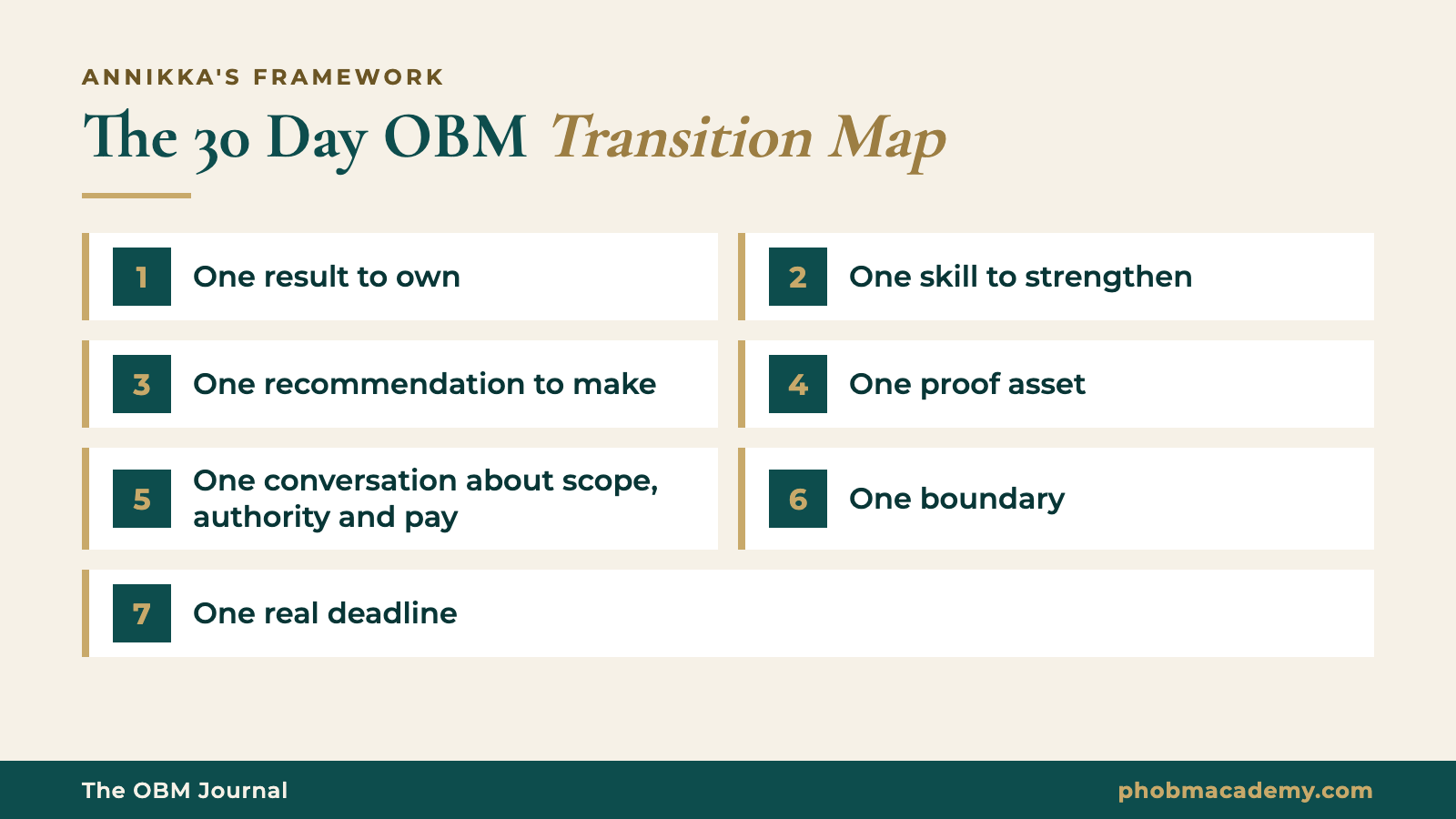
| Part of the map | What it means | Example (made up) |
|---|---|---|
| One result to own | A contained outcome you're clearly responsible for | "Every new client finishes onboarding within their first week." |
| One skill to strengthen | Your weakest of the 7 skill areas | Making recommendations |
| One recommendation to make | A written suggestion with an owner and a measure | Move all onboarding questions to one place |
| One proof asset | Something you can show later | A one-page onboarding audit summary |
| One conversation | About scope, authority and pay | A 20-minute call before you take on onboarding fully |
| One boundary | A limit you agree and keep | "Requests after my hours are handled the next working day." |
| One real deadline | A date that makes the month count | The audit summary goes to the client by day 21 |
If you finish the month with one owned result, one proof asset and one honest conversation, that's real progress. Most people skip the conversation. Don't.
How do I ask my client for a bigger role?
Ask after you've shown the thinking, not before. Lead with the result you want to protect, then ask for the agreement.
Here's the kind of message a VA would actually send. Say your client runs a coaching business and keeps losing track of new sign-ups:
"Hi Sarah! Quick thought before our call Thursday. I noticed a few new clients this month didn't finish onboarding, and I've been chasing them one by one. I'd like to propose taking full ownership of onboarding: one checklist, one place for questions, and a weekly update to you. Can we use 15 minutes Thursday to agree what that covers, what I can decide on my own, how many hours it needs, and how my rate changes with it? 🙂"
Notice what's in there: the result, the scope, the authority, the time and the pay. That's the boundary rule, written as a normal message.
And notice what's not in there: "I'm an OBM now." You don't need to announce the title. Show the work, then agree the role.
Why do so many VAs get stuck at this step?
They get stuck because they take on the bigger work first and hope the agreement follows. It usually doesn't.
You can see it on Reddit. A VA posted this week that after a promotion to a bigger role covering far more responsibility, the raise was so small it felt like "a slap in the face" (Reddit, Oct 12, 2026). Another VA posted that the work they were doing no longer matched the role they were hired for (Reddit, Oct 1, 2026). Those are individual stories, not proof of how every client behaves. But I recognize the pattern.
I lived a version of it. As a single mom running two businesses today, I'm careful with my time. That wasn't always true. My son grew up describing me with one word: "workaholic." My responsibilities grew long before my boundaries did. That's exactly why the boundary step comes before the bigger role, not after.
If you think you're already deep into OBM work without the agreement, read 7 signs you're already doing OBM work at VA pay.
How long does it take to go from VA to OBM?
There's no honest fixed timeline. It depends on your starting point, your client and how fast you can show owned results.
What I can tell you is what the first month should produce: one owned result, one proof asset and one conversation about scope, authority and pay. Some people get the bigger role with their current client. Some use the proof to win a new client. Either way, the proof is what moves you, not the calendar.
When you get to the pricing part, read how OBM pricing actually works for Filipino OBMs before you name a number.
FAQ
Can a virtual assistant become an online business manager?
Yes. Many OBMs started as VAs, and the OBM role was originally taught as a next step for experienced VAs. The move happens when you stop only completing tasks and start owning results: finding what's blocking a goal, recommending what to do, and taking responsibility for the fix. It works best with at least two years of real client experience behind you.
How long does it take to go from VA to OBM?
There's no fixed timeline, and anyone who promises one is guessing. It depends on your experience, your client and how quickly you can show owned results. A realistic first month gives you one result you own, one proof asset you can show, and one honest conversation with your client about scope, authority and pay. Repeat that, and the role follows the proof.
Do I need a new client to become an OBM?
Usually not at first. The easiest place to start is a client who already trusts you. Pick one contained result, like onboarding or weekly team follow-up, agree the boundary, and own it. Once you have a Proof Story from that work, you can use it to grow the role with that client or to win a new one.
What should I learn first to become an OBM?
Learn to make recommendations. Most experienced VAs are already strong at follow-through and planning. The skill that separates OBM work is looking at a problem, finding the real cause, and telling the client what you recommend, who owns it, and how you'll know it worked. Use the respectful recommendation structure until it feels natural.
Is the VA to OBM path for beginners?
No. OBM work is built on experience you already have: real clients, real deadlines, real people to coordinate. If you're brand new to online work, start by building that base. The free Philippine OBM Academy community on Facebook is a good place to learn alongside experienced VAs while you do.
What to do next
Find out where you're starting from. Take the free OBM Readiness Scorecard. It shows which skill areas you already use and what to build first, which makes your 30-day map much easier to fill in.
Then come talk about your map in our free Philippine OBM Academy community. If you're already doing OBM-level work and want guided practice on a full client engagement, OBM Pros starts December 2026.