Becoming an OBM
The 7 Online Business Manager Skills You Need (With a Self-Check)

Annikka AborroPublished Oct 13, 2026 · 9 min read
Short answer
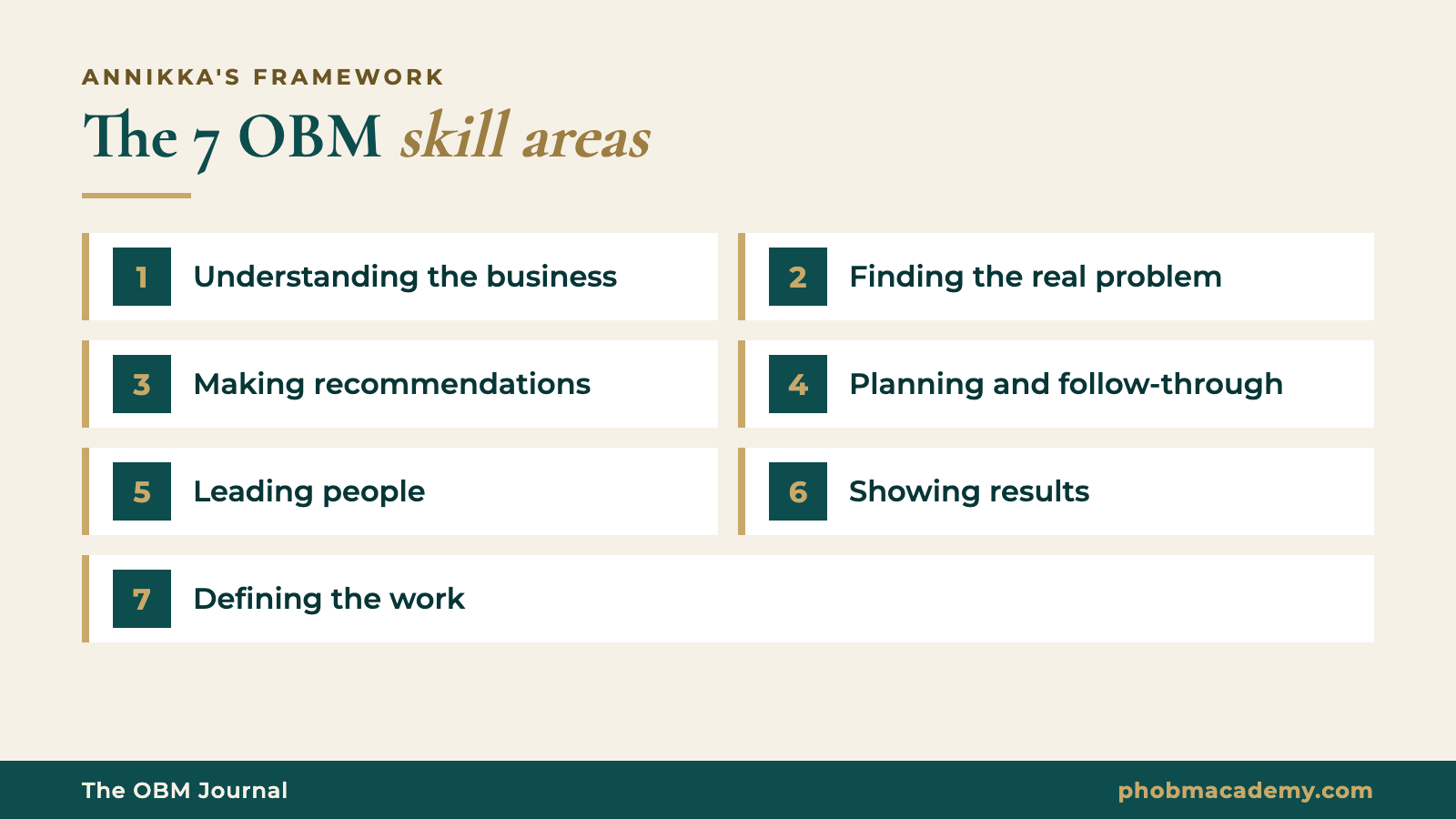
The online business manager skills clients hire for come down to seven: understanding the business, finding the real problem, making recommendations, planning and follow-through, leading people, showing results, and defining the work. Tools help, but they aren't the job. An OBM is hired for judgment: what result to protect, what's blocking it, and what to do next.
Free OBM Readiness Scorecard
A few minutes, a personalized result, and a clear next skill to practice.
Take the ScorecardKnowing ClickUp, Asana and Zapier doesn't make you an OBM.
I've worked online for 18 years. I started at 18 teaching English, then moved into virtual assistance, then grew into OBM work. I've seen VAs with a long list of tools still get treated like task-takers, and people with a much shorter list get trusted to run operations.
The difference is almost always the same seven online business manager skills. Not one of them is a piece of software.
If you're still fuzzy on what an OBM actually does, read what an OBM is first. This post goes one layer deeper: the skills underneath the role, and an honest way to check yours.
What skills does an online business manager need?
An online business manager needs seven skill areas: understanding the business, finding the real problem, making recommendations, planning and follow-through, leading people, showing results, and defining the work (scope). These are the seven areas I teach at the Philippine OBM Academy.
Here's the simplest way I explain the jump. Each role in a business answers a different question:
- A VA asks: what needs to be completed, and what does done look like?
- A project manager asks: what needs to happen, in what order, by whom, and by when?
- An OBM asks: what result are we protecting, what's blocking it, and what do I recommend next?
All seven skills come from that last question. I compare the three roles side by side in VA vs project manager vs OBM.
Why aren't tools on the list?
Because clients hiring at the OBM level look past your tools to your judgment. You can see it in the job posts themselves.
A September 2026 OnlineJobs.ph post for an Online Business Manager and Team Lead does list software. But it asks for confidence using AI "with the judgment to review its output," and it wants a weekly report that includes what needs the founder's decision (OnlineJobs.ph job post, Sep 26, 2026).
An August 2026 post for an executive assistant and OBM role says it plainly: "This is not an admin task list." The founder wants someone to prep her week, including what's stalled and what needs a decision (OnlineJobs.ph job post, Aug 12, 2026).
Tools change every year. These seven skills don't.
The 7 online business manager skills, explained
For each skill: what it means, what it looks like on a normal workday, and one self-check question.
1. Understanding the business
What it means: You know how the business makes money, who the customers are, what's being sold right now, and what the owner wants to achieve this quarter.
What it looks like: Before you start a task, you can say which goal it serves. When your client says "let's make a new freebie," you already know whether the real priority this month is the email list or booked sales calls.
Self-check: Could you explain your client's main offer, main customer and main goal for this quarter in three sentences, without looking anything up?
2. Finding the real problem
What it means: You don't just fix the thing the client points at. You look for what's actually causing it.
What it looks like: Your client says "we need a new CRM." Before comparing software, you check: are leads going cold because of the tool, or because nobody owns follow-up? One rule from my SCOPE framework: don't prescribe ClickUp, AI, or a new CRM before you understand the business problem. I break SCOPE down in how to handle scope creep.
Self-check: The last time something went wrong in your client's business, did you find the cause, or did you only clean up the mess?
3. Making recommendations
What it means: You bring a point of view, not just a report.
What it looks like: Instead of "the launch emails aren't done yet," you say what's blocking them, give two ways forward, and say which one you'd pick and why. A VA staffing agency's newsletter makes the same point from the client's side: flagging problems without proposing solutions puts the pressure back on the client (YourVAMatch Newsletter, Dec 31, 2025). I teach a full structure for this, called UPWARD, in how to write a client update that gets a decision.
Self-check: In your last three messages to a client about a problem, how many included what you recommend?
4. Planning and follow-through
What it means: You turn decisions into a plan with owners and dates, then you follow up until the work is actually done.
What it looks like: After a call, every action item goes into the project tool with one name and one date on it. You check progress before the client has to ask "any update?"
Self-check: If your client went offline for two weeks, would this month's priorities still move?
5. Leading people
What it means: You help other people do their best work. You brief them properly, check in, hold them accountable, and have the awkward conversation when something isn't working.
What it looks like: That Team Lead post from earlier describes it well. It asks for regular 1:1s, knowing what's in each person's way, and being the one the team comes to instead of the founder. The team are independent contractors, so the role leads through clarity and agreements, not a job title (OnlineJobs.ph job post, Sep 26, 2026).
Self-check: Is there anyone, a fellow VA, a designer, a freelancer, who comes to you first before they go to the client?
6. Showing results
What it means: You can show what changed because of your work, in numbers or in a clear before and after.
What it looks like: You say "new clients now get their welcome email the same day they pay, and we had zero 'where's my login?' messages this week." You don't say "I updated the onboarding automation."
Self-check: Can you name one result from the last 30 days that exists because of you?
7. Defining the work (scope)
What it means: You know what you've agreed to own and what you haven't. You speak up before the work quietly doubles.
What it looks like: When a new request lands, you check it against the goal and the agreement, then come back with options instead of an automatic yes.
Self-check: Is your current role written down somewhere your client has also seen and agreed to?
How do I check my own OBM skills?
Go through the seven questions and mark each one yes, sometimes, or not yet. Here they are in one place:
| Skill area | Self-check question | What "yes" looks like |
|---|---|---|
| Understanding the business | Can I explain the offer, customer and quarterly goal in three sentences? | You link every task to a goal without being told |
| Finding the real problem | Did I find the cause last time, or only clean up? | You ask "why is this happening?" before "which tool?" |
| Making recommendations | Do my problem messages include what I recommend? | Options plus your pick, every time |
| Planning and follow-through | Would priorities move if the client went quiet? | Owners and dates on everything, checked weekly |
| Leading people | Does anyone come to me before the client? | People ask you for direction and you give it |
| Showing results | Can I name one result from the last 30 days? | A before and after you can say in one sentence |
| Defining the work | Is my role written down and agreed? | A short scope your client has seen and agreed to |
How to read your answers:
- Mostly yes: you're probably already doing OBM-level work. Your gap is more likely how you define, position and price that work than the skills themselves.
- A mix: that's normal. People coming from task-based roles often score lower on recommendations and scope, because task roles rarely ask for a point of view.
- Mostly not yet: don't panic, and don't rename yourself yet. Start by owning one contained result (more on that below).
This quick check is a starting point, not a score. For a fuller read on where you stand and what to work on first, take the free OBM Readiness Scorecard. Your results come by email.
Which OBM skill should I build first?
Build whichever skill helps you own one contained result for a client you already have. Skills grow fastest when there's a real result attached to them.
Pick one result you could own from start to finish:
- onboarding completed properly
- a launch
- weekly content production
- lead follow-up
- one key project kept on schedule
- weekly team accountability
- one process that keeps causing delays
- getting the team to actually use a new tool
Then match the skill to the result. If you pick lead follow-up, you're practicing "finding the real problem" (why do leads go cold?) and "planning and follow-through" (who follows up, when, and how do we check?).
One warning before you take anything bigger on. Agree the result, scope, authority, time and compensation before you expand your role. Please don't act like an OBM for free until someone notices.
I'm saying this because I lived it. My clients slowly started relying on me for much more than tasks. I organized projects, coordinated contractors, improved processes, followed up with team members and recommended what should happen next. My responsibilities grew before my title, pricing, authority and boundaries did. In my own words: "I had become extremely valuable to my clients, but I had not learned how to turn that value into authority, boundaries, and a sustainable service."
Can a virtual assistant learn OBM skills?
Yes. Most of these skills are built on the job, by doing slightly bigger versions of what you already do.
When I discovered the OBM role, the work itself was familiar. What changed was learning to define it, structure it, price it and lead it. That's the part most experienced VAs are missing, and it's learnable.
If you're coming from a corporate PM or team lead role, you probably already have planning and leading people. The newer parts tend to be understanding a founder-led business from the inside and making recommendations without a big org chart behind you.
Frequently asked questions
What is the most important skill for an online business manager?
Making recommendations is the skill clients notice first. A VA reports what happened. An OBM explains what's blocking the result, gives real options, and says which one she'd choose and why. That's what earns trust to run things. It only works if you also understand the business and find the real problem first, so the seven skills support each other rather than standing alone.
Do I need to know a lot of tools to become an OBM?
No. You need to be comfortable learning tools, but tools aren't what clients hire an OBM for. Job posts for OBM roles list software, yet they also ask for judgment, ownership and clear updates on what needs a decision. A new app takes a weekend to learn. Knowing which problem to solve first takes practice, so put most of your energy there.
Can I build OBM skills while I'm still working as a VA?
Yes, and that's usually the best place to build them. Pick one contained result with a client you already have, like onboarding or lead follow-up, and own it from start to finish. Agree the scope, authority, time and compensation before you take it on, so you aren't doing manager-level work quietly and for free while your role stays the same.
How long does it take to build OBM skills?
There's no fixed timeline, and anyone who promises one is guessing. It depends on how much ownership your current clients give you and how often you practice recommending, planning and reporting results. The fastest way I know is to own one real result at a time, write down what you changed, and use that as proof for the next, bigger result.
Is this self-check the same as the OBM Readiness Scorecard?
No. The self-check in this post is a quick reflection you can do in your head. The free OBM Readiness Scorecard on the Philippine OBM Academy site is a fuller assessment that shows how much of the role you already do and what to work on first, with your results sent by email. Use the self-check to start thinking, then take the scorecard for a proper read.
Your next step
Find out where you really stand. Take the free OBM Readiness Scorecard, then bring your results to the free OBM community on Facebook, where we talk about this work every week.
If you're ready to practice these seven skills with live feedback on a realistic client engagement, look at OBM Pros, which starts December 2026.