
Pricing and Positioning
How OBM Pricing Actually Works for Filipino OBMs

Annikka AborroPublished Oct 13, 2026 · 9 min read

Short answer
OBM pricing follows six things: the problem you solve, the scope, the decisions you carry, the people you lead, the proof you can show and the responsibility you take. Not the title. Most OBMs price with hourly, retainer, project or paid audit models, and agree the result, scope, authority, time and pay before the role grows.
Free OBM Readiness Scorecard
A few minutes, a personalized result, and a clear next skill to practice.
Take the ScorecardA rate range you copied from a Facebook comment is the least useful number in your whole business.
It tells you what someone else charged, for a scope you can't see, to a client you don't know. That's why this post explains how OBM pricing works without a single rate range in it. On purpose. If you understand what drives the price, you can build your own number and defend it.
New to the role? Read What Is an Online Business Manager? first.
How OBM pricing works: what does the price actually follow?
OBM pricing works by matching the price to the weight of what you're responsible for. The more problem, scope, decisions, people, proof and responsibility involved, the more the work is worth, whatever you call yourself.
Here's how I teach it. Ask these six questions before you think about a number.
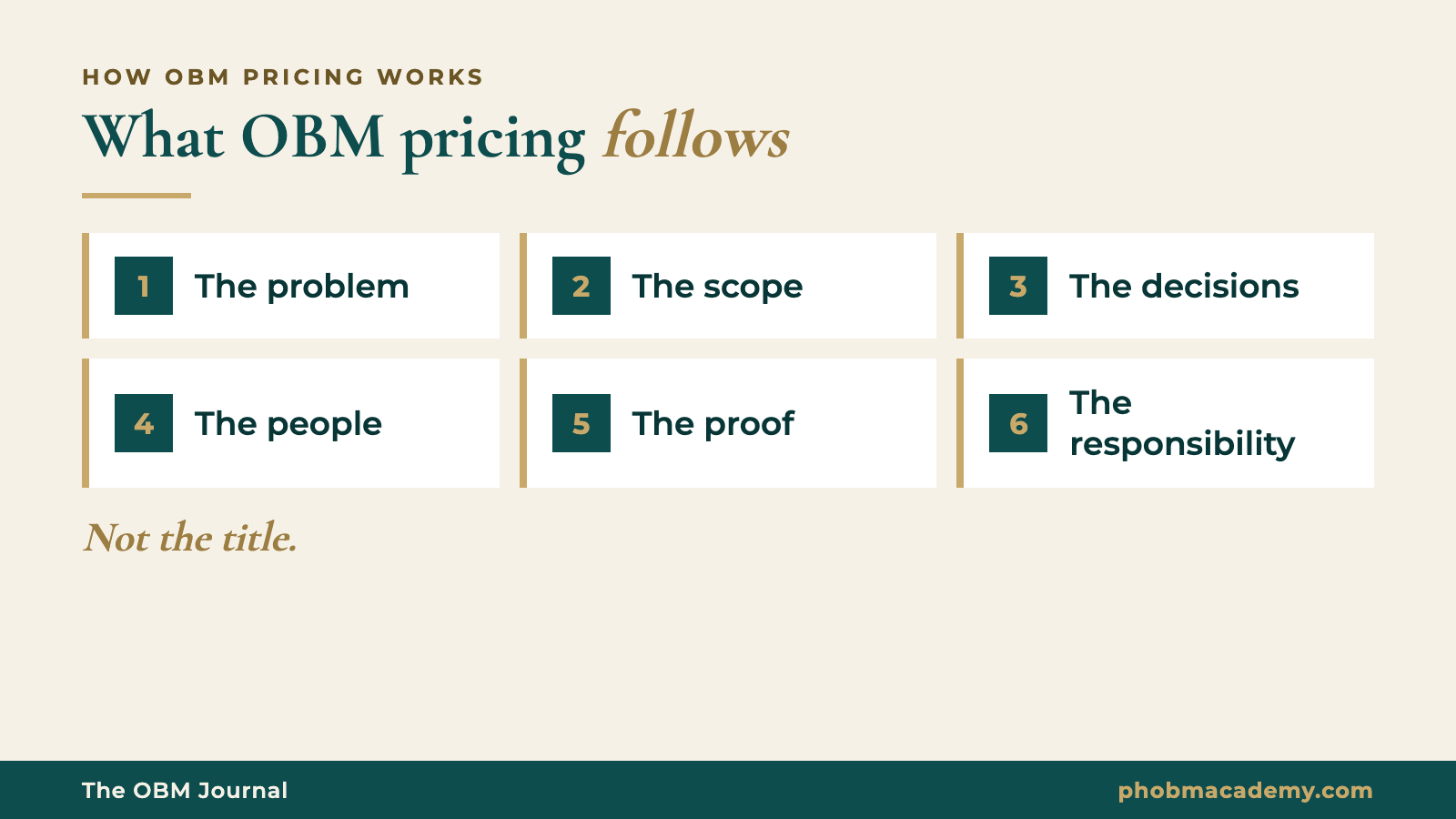
| What price follows | The question to ask | What makes it heavier |
|---|---|---|
| The problem | What business problem am I solving? | It's costing the client money, clients or launches |
| The scope | What exactly is included, and what isn't? | More areas of the business, more moving parts |
| The decisions | What am I allowed to decide without asking? | You decide priorities, not just tasks |
| The people | Who am I leading or coordinating? | A team, contractors, other VAs |
| The proof | What results can I show from similar work? | Clear before and after, written up |
| The responsibility | What am I accountable for if it goes wrong? | You own the result, not just the effort |
Notice that "years of experience" and "my title" aren't on the list. They matter only when they show up as proof and responsibility.
Why doesn't the OBM title set the price?
Because clients don't pay for a title. They pay for a problem to go away.
Here's a line from my Launchpad material: "Calling yourself an OBM does not justify a higher price. Carrying wider responsibility, making sound recommendations, and helping the business produce better results does."
You can see why on any job board. Search "online business manager" on OnlineJobs.ph and the titles range from "Executive Assistant / Online Business Manager" to "Online Business Manager & Team Lead" (search results). Same title words, very different responsibility. If you want to see the difference in the actual work, read VA vs project manager vs OBM.
What pricing models do OBMs use?
Most OBM work is priced in one of four ways: hourly, retainer, project or paid audit. Each one fits a different stage of the work, and none of them is "the right one" for every client.
| Model | How it works | When it fits | Watch out for |
|---|---|---|---|
| Hourly | The client pays for the time you work | Early days, unclear or irregular work | You get paid less for getting faster, and the scope can grow quietly |
| Retainer | A fixed fee each period for agreed services, hours or deliverables | Ongoing operations with a steady need | Vague scope, unclear rules on unused hours |
| Project | One fee for a defined outcome with a start and end | A launch, a migration, a system setup | The brief changing halfway through |
| Paid audit | A fixed fee to diagnose the problem and recommend a plan | Before any bigger engagement | Giving the audit away free on a "quick call" |
Hourly is simple and familiar. It's fine for task work. It gets tricky for OBM work, because the most valuable part of your job is often thinking, and thinking doesn't always look like logged hours.
A retainer is a contract between a client and a service provider for ongoing work, usually paid regularly (Dropbox Sign). That same guide lists what a retainer agreement should spell out: the services and deliverables or hours per period, timelines and availability, payment terms including whether unused hours roll over, who owns the work, and how either side can end it. For an OBM, add one more line: what you're allowed to decide.
A project has an end. It works well for something like a launch or a system setup. The risk is the brief moving after you've agreed the price. A seller on the Fiverr Community described a client who changed the direction after delivery and then wanted extra work for free; one reply put it simply: document everything, offer a paid revision, and "don't cave for free" (Fiverr Community, thread started March 2026, replies into September 2026).
A paid audit is where I recommend most OBM engagements start. More on that next.
What is the OBM client pathway?
The client pathway is the order I teach for turning a conversation into a paying OBM engagement: Discovery Call, then Paid Audit, then 90 Day Implementation, then Retainer. Each step has a different job, and a different way of pricing it.
- Discovery Call. You check fit. Is there a real problem, and are you the right person for it? It's free because it's short and it's about fit. It is not free consulting. If you start solving the problem on the call, you've just given away the audit.
- Paid Audit. You dig into the business and deliver clarity: what's really going on, what's blocking the result, and what you recommend. It's priced as a fixed fee for a defined deliverable, like an audit summary with a recommended plan.
- 90 Day Implementation. You lead the agreed priorities from the audit. This is usually priced as a project or a fixed monthly fee for a set period, because the scope came out of the audit.
- Retainer. Only when there's a real ongoing need. After 90 days, you know what the ongoing work actually is, so the retainer is built on facts, not guesses.
Why this order? Because every step makes the next price easier to set. You can't price a retainer well for a business you haven't diagnosed.
What should you agree before your OBM role expands?
Agree five things before you take on more: the result, the scope, the authority, the time and the compensation. That's my boundary rule, and it applies to new clients and to the client you already have.
- Result: what outcome are you responsible for?
- Scope: what's in, and what's out?
- Authority: what can you decide without asking?
- Time: how many hours or how much availability does this need?
- Compensation: how does your pay change with the new responsibility?
The order matters. It's much easier to agree pay before you say yes than after.
You can see what happens otherwise on Reddit. A VA described being promoted into far more responsibility for a raise so small it felt like "a slap in the face." One of the replies was blunt: you accepted it, so you can't complain (Reddit, Oct 12, 2026). That's harsh, and it's one person's story. But it shows why the conversation has to come before the yes.
Another VA asked Reddit who to talk to about a rate increase when the client wanted to add more specialized tasks: the client, or the agency that hired them. A reply suggested going through the agency first, since going straight to the client could cause problems with the contract. Then the VA checked the contract and found the new tasks were already written into its scope (Reddit, Oct 4, 2026). That's the lesson: read your scope before you negotiate, and know who your agreement is actually with.
Never act like an OBM for free until someone notices. In my experience, nobody notices. They just get used to it.
How do you talk about price when the client adds more work?
Answer the request warmly, then move it into a scope conversation before you start. Here's a made-up example of a message you might get:
"hey! can you also take over managing the other VAs? 🙏 same rate for now and we can revisit later"
And here's a reply an experienced VA could actually send:
"Happy to help with this, and thanks for trusting me with the team! Before I take it on, let's agree what 'managing the VAs' covers: daily check-ins, task reviews, onboarding new hires? I'll send you a one-page scope with what's included, what I can decide on my own, the hours it needs and the updated rate, so we can start clean on the 1st. Does Thursday work to go through it? 🙂"
Notice what this does. It says yes to the work, not to "same rate for now." It turns "we can revisit later" into a specific date. And it puts all five parts of the boundary rule on the table.
If your role has already grown without that conversation, read 7 signs you're already doing OBM work at VA pay.
How do I set my own OBM price without copying someone's rate?
Build it from your scope, not from someone else's number. Here's the order I'd follow.
- Write the client's problem in one sentence.
- Write the scope: what's in and what's out.
- List the decisions you'll own and the people you'll lead.
- Gather your proof: one or two written examples of similar results.
- Pick the model that fits the stage. If the problem isn't clear yet, start with a paid audit.
- Put it in writing with a review date, so the price can grow when the responsibility does.
If you're not sure where your skills stand yet, the free OBM Readiness Scorecard gives you a separate read on how you position and price your work. And if you're still moving from VA work into this, start with how to go from VA to OBM in the Philippines.
FAQ
Do OBMs charge hourly or a monthly retainer?
Both are common, along with project fees and paid audits. Hourly works for early or irregular work. A retainer works for ongoing operations with a steady, clearly defined need. Many OBMs start a new client with a paid audit, then a set implementation period, and only move to a retainer once the ongoing work is clear. Pick the model that fits the stage, not the one everyone else uses.
What is included in an OBM retainer?
A good retainer spells out the services, hours or deliverables per period, your availability and response times, payment terms, whether unused hours roll over, who owns the work, and how either side can end the agreement. For OBM work, also write down the result you're responsible for and what you can decide without asking. Vague retainers are where scope quietly grows.
What is a paid audit and why do OBMs start with one?
A paid audit is a fixed-fee engagement where you diagnose what's blocking a business result and deliver a written recommendation and plan. It comes after a short discovery call and before any bigger engagement. It protects you from giving away free consulting, and it gives the client clarity before they commit. It also makes every later price easier to set, because you know the real scope.
How do I raise my rate when my role grows?
Treat it as a scope agreement, not a favor. Write down what you now own, which decisions you make, who you lead and the hours it takes, with recent examples. Then ask for a short meeting to agree the updated role and how your pay reflects it. Do this before you take on the new work if you can. It's much harder after you've already said yes.
How do I know if I'm undercharging as an OBM?
Compare your agreement to your actual responsibility. If you're leading people, making decisions or owning results that aren't in your agreement, your price was set for a smaller job. Rate ranges online won't tell you this, because they hide the scope behind them. Your own written scope, set against what you actually do each week, will.
What to do next
Start with an honest read on your work. The free OBM Readiness Scorecard scores both what you can deliver and how you position and price it.
Then bring your pricing questions to our free community, the Philippine OBM Academy group on Facebook. If you want structured practice running a full client engagement from audit to recommendation, see OBM Pros, starting December 2026.