Becoming an OBM
How to Prove OBM Experience Without the OBM Title

Annikka AborroPublished Oct 13, 2026 · 9 min read

Short answer
To prove OBM experience without the title, show the responsibility you carried, not the title you had. Write a Proof Story for each result: what was happening, what you noticed, what you recommended, what you owned, what changed, what you learned. Back each one with a client-ready proof asset, like a project plan.
Free OBM Readiness Scorecard
A few minutes, a personalized result, and a clear next skill to practice.
Take the ScorecardChanging your headline to "OBM" proves nothing.
A title is a claim. Clients want evidence. If you're wondering how to prove OBM experience when your contract still says VA, EA or coordinator, the evidence usually already exists. It's just buried in your chats, your docs and your memory.
Here's how I know. When it clicked for me, my title was still VA. I was being invited to leadership meetings. I was managing people and making sure they did what they were supposed to. Whenever something went wrong, I was the one proposing a solution. I was leading all the meetings.
That was OBM work. Nobody had called it that, including me.
In 18 years I've learned the gap usually isn't the work. It's the proof. Back then, I had become extremely valuable to my clients, but I had not learned how to turn that value into authority, boundaries, and a sustainable service. Proof is a big part of that.
Can I call myself an OBM if I never had the title?
You can describe OBM work you've actually done, but don't claim a title you never held. Clients check, and a mismatch costs you trust fast.
The honest version is stronger anyway. Write something like "Operations lead for a coaching business (title: Executive Assistant)," and let your proof do the talking.
Calling yourself an OBM doesn't justify a higher price. Carrying wider responsibility, making sound recommendations, and helping the business produce better results does. Your proof has to show those three things.
Still sorting out which role you've really been doing? Start with VA vs project manager vs OBM and the plain definition of what an OBM is.
What do clients ask for when they hire an OBM?
Clients ask for evidence that you owned an outcome, not for a title. Look at what real job posts ask applicants to send.
A September post for a remote operations manager asks applicants to describe "a time you took ownership of a messy project" and got it finished on deadline (OnlineJobs.ph job post, Sep 24, 2026). Another, for an Online Business Manager and Team Lead, asks: "Tell us about a team you've led: its size, what you were responsible for" (OnlineJobs.ph job post, Sep 26, 2026).
Neither asks for your title. They ask what you owned.
The same advice showed up on Reddit this month. A BPO supervisor asked whether her experience could go in a VA portfolio. One reply told her to show proof of what she could do for a client: "Show me, don't just tell me." Another said to rewrite her CV around results instead of job duties (Reddit, Oct 6, 2026).
What counts as OBM experience?
OBM experience is any time you carried responsibility for a business result: you understood the goal, found what was blocking it, recommended a fix, led people or a project, and showed what changed. It counts even if your title was smaller.
I teach seven OBM skill areas. Here's what counts as evidence for each one, and the proof asset that shows it. (The full breakdown of the skills is in the 7 skills an OBM needs.)
| Skill area | What counts, even without the title | Proof asset that shows it |
|---|---|---|
| Understanding the business | You can explain how the client makes money and which result matters most right now | Audit summary |
| Finding the real problem | You traced a recurring delay to its cause instead of patching it again | Process improvement recommendation |
| Making recommendations | You proposed a change and the client agreed | Recommendation message or one-page memo |
| Planning and follow-through | You ran a launch or project to its deadline | Project plan |
| Leading people | You kept contractors or teammates accountable | Team accountability structure |
| Showing results | You reported progress against a goal, not just tasks done | Weekly operations update or simple KPI report |
| Defining the work | You clarified what was in and out before taking on more | Scope note or 90 Day Implementation Plan |
How to prove OBM experience with a Proof Story
Write a Proof Story: a short account of one result you were responsible for, built on six questions. It's the framework I teach for exactly this problem.
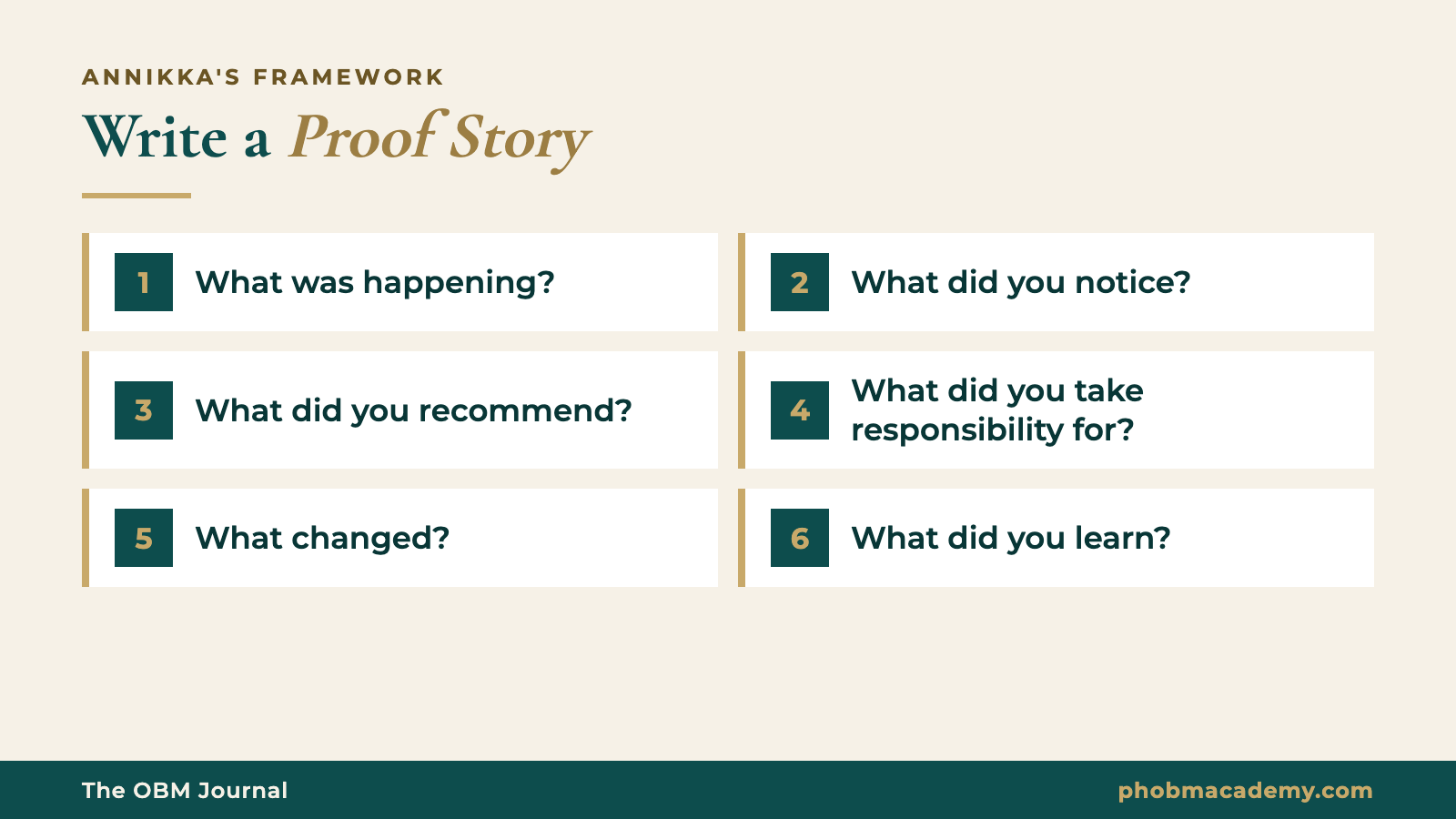
- What was happening? The situation and why it mattered to the business.
- What did you notice? The pattern or cause others missed.
- What did you recommend? Your actual recommendation, in a sentence or two.
- What did you take responsibility for? The part you owned, not the part you helped with.
- What changed? The result, as specific as you're allowed to share.
- What did you learn? What you'd do differently, which shows judgment.
Here's a made-up example so you can see the shape.
Example Proof Story (fictional): A course creator I supported was answering the same "I can't find my login" emails herself every week, right before each new cohort started. I noticed the welcome email went out before students were added to the course platform, so the link didn't work for the first day. I recommended we change the order: add students first, then send the welcome email, and add a short checklist to the enrollment process. I took responsibility for the checklist and for checking every new enrollment for two cohorts. Access emails dropped off, and she stopped handling support during launch week. What I learned: fix the order of steps before adding another tool.
Notice what's missing: the job title. Nobody reading it cares whether it was a VA or an OBM. They can see the judgment. Compare it with a duty line like "Managed client inbox and student support." That's a task list.
What proof assets should I build?
Build client-ready proof assets: documents a founder would actually use, with confidential details removed. These are the ones I recommend, and what each one proves:
- Audit summary. Proves you can look at a business and find what matters.
- Project plan. Proves you can turn a goal into owners, steps and deadlines.
- Weekly operations update. Proves you report on results and ask for decisions. If you need a structure, use the UPWARD client update.
- Process improvement recommendation. Proves you fix causes, not symptoms.
- Simple KPI report. Proves you track what matters, not just what's easy to count.
- Team accountability structure. Proves you can lead people: who owns what, by when, and how follow-up works.
- 90 Day Implementation Plan. Proves you can lead a set of agreed priorities over time.
You don't need all seven. Two or three strong ones, each tied to a Proof Story, beat a folder of screenshots.
Can I show client work without breaking confidentiality?
Yes, if you share your thinking and structure, not the client's private files. When in doubt, ask permission in writing first.
This is a real risk. In September, a video editor posted on Reddit that a brand they'd worked with for a long time told its contractors to delete all the work they'd made for it from their portfolios and LinkedIn within 24 hours. There was no NDA. The replies split, but the careful ones agreed on a few things: check your contract for who owns the work, ask permission, and link to the client's public version instead of sharing files. One commenter put it plainly: the professional move is "not to share any files without express permission" (Reddit, Sep 26, 2026).
Operations work is often more sensitive than a video, because it shows how a business runs. My rules:
- Remove names and identifiers. Client, team members, products, tools that reveal who it is.
- Describe results without private numbers. "Support emails during launch dropped noticeably" is safer than exact figures, unless the client approves.
- Rebuild, don't copy. Recreate the plan or report as a clean template with sample data.
- Ask in writing. A short message like "Can I describe this project in my portfolio without your name?" protects the relationship.
- Never share the client's actual files.
Where should I put my proof?
Put it in one simple portfolio page you can send with any application, and mirror the best pieces on LinkedIn.
Here's what goes on that page, in order:
- Your positioning line. "I help [who] solve [what problem] so they can [result]." This is how I teach people to position by the problem they solve. The corporate PM to online OBM guide walks through writing one.
- Three Proof Stories. One per result, each under 150 words.
- Two or three proof assets. Cleaned-up versions, as PDFs or images.
- How you work. A sample weekly update and how you handle scope.
- How to reach you.
On LinkedIn, put your strongest asset and story in Featured, and rewrite each role around results, not duties.
What if my boss or client gets the credit for my work?
Then start sending your own updates. If your work only shows up through someone else, nobody else sees your judgment.
A project manager described this on Workplace Stack Exchange this month: doing much of the real work on a project while their boss presented it upward, with the praise not traveling past him (Workplace Stack Exchange, Oct 1, 2026).
In an online business, the fix is simpler. Send the founder a short weekly operations update in your own name, with what you protected, what's blocked, and what you recommend. Save every one. In three months you'll have a record most applicants don't.
How do I get OBM experience if I've never led anything?
Own one contained result first, with the boundaries agreed up front. That's how you create proof instead of waiting for it.
Good first results to own: onboarding done properly, one launch, weekly content production, lead follow-up, one key project on schedule, weekly team accountability, or one process that keeps causing delays.
My boundary rule: agree on the result, scope, authority, time and compensation before you expand your role. Don't act like an OBM for free until someone notices. That's how I ended up valuable but unseen, and I don't want it for you.
Frequently asked questions
Can I put client work in my OBM portfolio?
You can show your thinking and structure, but not the client's private files. Remove names and identifiers, rebuild documents as templates with sample data, and describe results without confidential numbers unless the client approves. When you're unsure, ask in writing whether you can describe the project without their name. Check your contract, because some agreements say the client owns everything you produce.
Does a course or certificate prove OBM experience?
A course shows you've studied the role. It doesn't prove you've done it. Clients want to see a result you were responsible for, so pair any training with Proof Stories and proof assets from real work. If you don't have those yet, own one contained result with agreed scope, then document it. Training helps most when it gives you practice and feedback on real-style work.
How many Proof Stories do I need?
Three strong ones are enough to start. Pick results that show different skill areas, for example one where you found the real problem, one where you led people, and one where you reported results and got a decision. Keep each under 150 words. Three specific stories beat ten vague ones, and you can swap them depending on what each client cares about.
What if my client won't give me a testimonial?
You don't need one to prove your experience. A Proof Story and a cleaned-up proof asset show your judgment directly. If you'd still like a testimonial, make it easy: ask one specific question, like what changed after a project you led. Some clients prefer a private reference call over a public quote, so offer that option too.
Can corporate experience count as OBM experience?
Yes, when you carried responsibility for results: leading projects, managing people, improving processes, reporting to leadership. What changes online is the context. Founder-led businesses move faster, have smaller teams and fewer formal processes. Translate your corporate work into the business problem you solved, then write Proof Stories in plain language a founder would recognize.
Your next step
Not sure which of your experiences count? Take the free OBM Readiness Scorecard. It shows where your proof is strong and where it's thin. Then join the free OBM community on Facebook and share your first Proof Story for feedback.
If you want to build a reviewed portfolio through a simulated client engagement, take a look at OBM Pros. It starts December 2026.