
Becoming an OBM
Corporate Project Manager to Online Business Manager: How to Make the Move Without Starting Over

Annikka AborroPublished Oct 13, 2026 · 9 min read

Short answer
You can go from corporate project manager to online business manager without starting over, because planning, leading people, reporting and fixing processes all transfer. What changes is the context. Founder-led businesses move faster, have fewer layers and want recommendations, not status reports. Translate your experience into business problems solved, then position yourself by that problem.
Free OBM Readiness Scorecard
A few minutes, a personalized result, and a clear next skill to practice.
Take the ScorecardThe fastest way to waste ten years of corporate experience is to apply for entry-level VA jobs "just to get in."
If you're a project manager, team lead or ops supervisor planning the move from corporate project manager to online business manager, you don't have to start over. You do have to translate. Founders don't hire titles or org charts. They hire someone who can take a mess off their plate.
I came to OBM work from the other direction: I started online at 18, teaching English, then as a VA, and grew into OBM work over 18 years. The Academy I run serves two groups, experienced VAs and corporate PMs and ops pros. They get stuck in different places. This post is for the second group.
How do I go from corporate project manager to online business manager?
Keep your experience, change the language and learn the context. That's four moves:
- Learn how founder-led online businesses run. They're smaller, faster and less documented.
- Translate your experience into business problems you solved. Not duties, not tools, not acronyms.
- Position yourself by one problem. Pick the problem you're best at solving and say it in a founder's words.
- Own one contained result online, with the scope and authority agreed up front, and turn it into proof.
You're not alone in worrying that your experience won't count. On October 3, someone with years of healthcare operations work (team coordination, scheduling, reports, stakeholders) asked Reddit how to move into remote work with zero formal VA experience, and wrote: "I'm not necessarily looking to start over completely" (Reddit, Oct 3, 2026).
Three days later, a BPO supervisor with eight years of experience posted on Reddit that she wanted to move into VA work but worried she had zero VA experience. She asked if that experience could even go in a portfolio (Reddit, Oct 6, 2026).
Replies told her she wasn't starting from zero. They said to connect her experience to the service she wanted to offer, and to highlight team coordination, reporting, client communication, problem solving, process improvement and handling escalations. Another reply added a warning I agree with: go slowly and don't leave your job yet, because the stability you have as an employee is "literally gone" once you go independent (same Reddit thread).
Both are right. Your experience counts. The ground under you is different.
What corporate skills transfer to OBM work?
Most of your hard skills transfer: planning, sequencing, managing stakeholders, reporting, documentation and leading people. What changes is the question you're hired to answer.
I teach the difference with three questions:
- A VA asks: What needs to be completed, and what does done look like?
- A project manager asks: What needs to happen, in what order, by whom, and by when?
- An OBM asks: What result are we protecting, what is blocking it, and what do I recommend next?
Most corporate PMs are excellent at the second question. Online founders hire an OBM for the third. That's the real gap, and it's smaller than starting over.
The what is an OBM page has the full list of what transfers and what doesn't. Here's how the day-to-day changes.
| In corporate | In a founder-led online business | What to do about it |
|---|---|---|
| Projects come with a sponsor, a charter and a budget line | The founder gives you a goal in a voice note, sometimes half-formed | Ask what result you're protecting before you plan anything |
| Authority comes with your position | Authority comes from trust you earn, result by result | Agree your authority in writing for each result you own |
| Decisions go up through layers | You talk to the decision-maker directly, often the same day | Bring options and one recommendation, not just status |
| Processes mostly exist | Often nothing is written down | Document as you go |
| Your team is employees, with HR behind them | Contractors and part-timers across time zones | Keep it simple: one owner, one date, one follow-up |
| Reports exist for governance | Updates exist to get decisions | End every update with the decision you need |
| Tools and methods are standardized | The founder may ask for a new tool before knowing the problem | Understand the business problem before prescribing any tool |
That last row is one of my rules: "Do not prescribe ClickUp, AI, or a new CRM before you understand the business problem." Founders don't need your favorite tool. They need the bottleneck found.
Job posts say this plainly. A September post for a remote operations manager reads: "the CEO sets the direction; you own how it actually gets done" (OnlineJobs.ph job post, Sep 24, 2026). Another, for an Online Business Manager and Team Lead, asks for "3+ years leading a team in an online course, membership, or coaching business" (OnlineJobs.ph job post, Sep 26, 2026).
Notice that second requirement. You probably have the leadership part. The online business context is what you'll need to build.
Why do corporate PMs end up starting over?
Usually because of how they present themselves, not because of their skills. I see three traps.
Trap 1: Applying for VA titles to "get in." You'll be judged on tasks and managed like a VA. It's hard to grow out of a role you accepted as the entry point.
Trap 2: Leading with frameworks and acronyms. A founder with a launch in two weeks doesn't care about your methodology. She cares whether the launch ships without her chasing everyone.
Trap 3: Waiting for a mandate. Online, the founder often expects you to find the problem yourself and come back with a recommendation.
There's an upside here. On Workplace Stack Exchange this month, a project manager in a hierarchical company described doing much of the real work on a project but not being invited into the room when it was discussed with senior leadership (Workplace Stack Exchange, Oct 1, 2026). In a founder-led business, you're usually in the room from the first week. That's exposure and opportunity at the same time.
How do I position myself by the business problem I solve?
Use one sentence: "I help [who] solve [what problem] so they can [result]." It's the positioning line I teach, and it works because it speaks the founder's language instead of your résumé's.
Here's a made-up before and after.
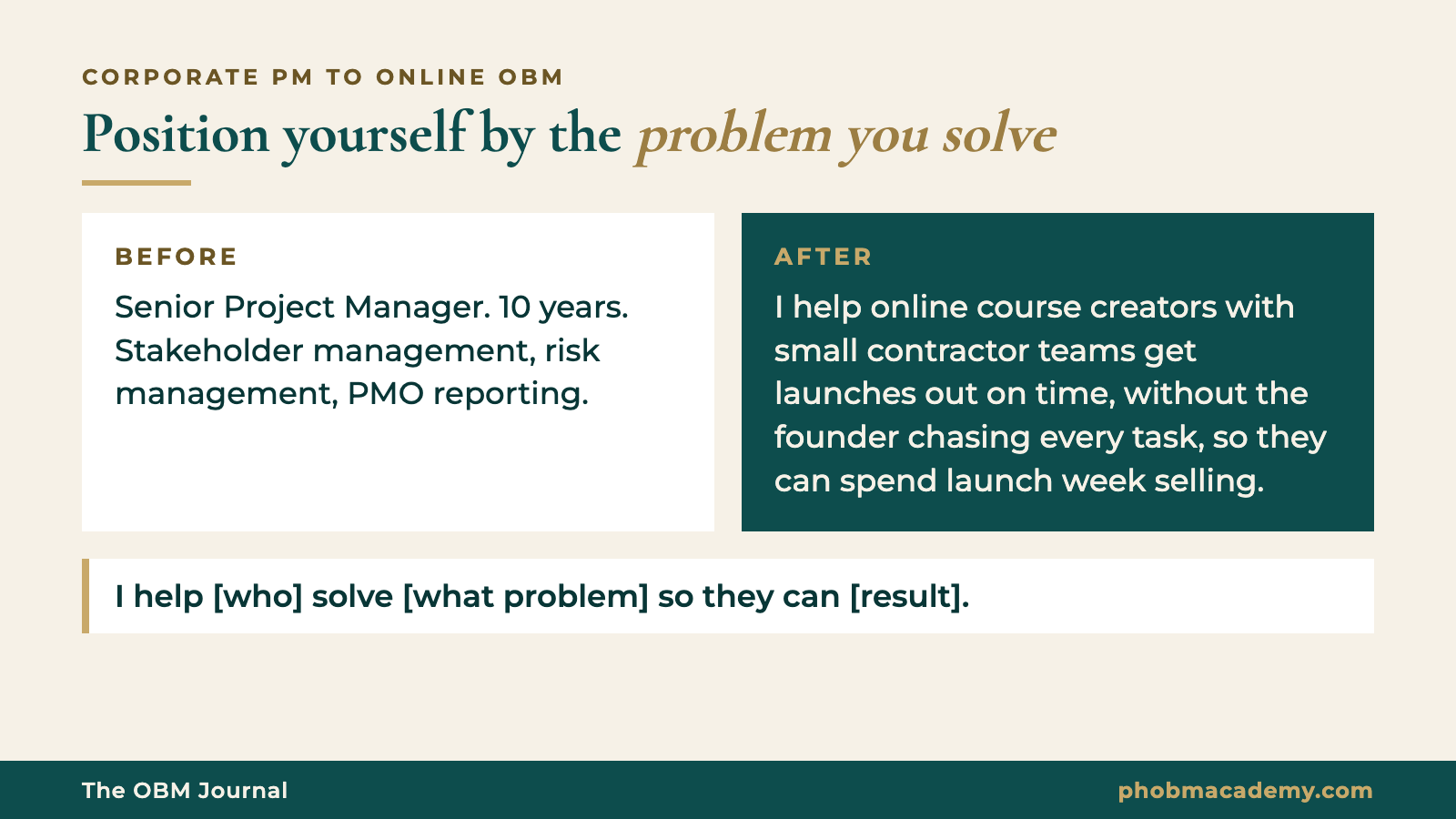
Before: "Senior Project Manager. 10 years. Stakeholder management, risk management, PMO reporting."
After: "I help online course creators with small contractor teams get launches out on time, without the founder chasing every task, so they can spend launch week selling."
Same person. The second one tells a founder why to book a call.
To write yours:
- Who: pick one kind of founder-led business you understand or want to serve (coaches, course creators, agencies, service firms).
- What problem: choose a problem you've actually solved in corporate, described the way a founder would say it ("launches always run late," "new clients fall through the cracks").
- What result: what the founder gets back. Time, fewer complaints, a launch that ships, a team that doesn't need her for every decision.
You're not "a PM looking for work" anymore. You're the person who fixes one specific, expensive problem.
How do I explain my corporate experience to a founder?
Translate it from corporate language into results a founder recognizes. Here are a few common lines, rewritten.
| Corporate phrasing | Founder phrasing |
|---|---|
| "Managed cross-functional stakeholders" | "Got people who didn't report to me to deliver on time" |
| "Owned PMO governance and reporting" | "Gave leadership a weekly view of what was on track, what was at risk, and what they had to decide" |
| "Drove process improvement initiatives" | "Found why the same delay kept happening and fixed the cause" |
| "Handled client escalations" | "Calmed down unhappy clients and fixed what upset them" |
Then back each line with a short story. I teach a structure called the Proof Story: what was happening, what you noticed, what you recommended, what you took responsibility for, what changed, and what you learned. The full guide is here: how to prove OBM experience without the OBM title.
Leave out anything confidential. Describe the problem and your judgment, not your employer's private data.
Do I have to start as a VA if I have corporate experience?
No. But you do need to start with one contained result, because founders want to see you deliver in their world before they hand you the whole operation.
Good first results to own:
- Client onboarding done properly
- One launch
- Weekly content production
- Lead follow-up
- One key project on schedule
- Weekly team accountability
- One process that keeps causing delays
- Getting the team to actually use a new tool
My boundary rule: agree on the result, scope, authority, time and compensation before you expand your role. Never act like an OBM for free until someone notices. If you do take a role with a smaller title while you learn, agree from day one which result you own and when you'll review the role together.
For the bigger picture, read how to go from VA to OBM in the Philippines. Most of it applies to you too.
What should my first 30 days look like?
Use the 30 Day OBM Transition Map, a framework I teach for exactly this stage. You can start it while you're still employed.
- One result to own. Pick a contained result from the list above, ideally with one founder you already know.
- One skill to strengthen. For most corporate PMs, it's writing short updates that end in a recommendation.
- One recommendation to make. Find one thing that's slowing the business down and recommend a fix.
- One proof asset. A project plan, weekly operations update or process recommendation you can show later, with details removed.
- One conversation about scope, authority and pay. Have it before the work grows, not after.
- One boundary. Working hours, response times or what's out of scope. Decide it and say it.
- One real deadline. Something with a date the founder cares about, so your result is visible.
Thirty days won't make you an OBM. It will give you one result, one proof asset and an honest read on whether founder-led work suits you.
Frequently asked questions
Can a project manager become an online business manager?
Yes. Project managers already plan, sequence work, manage stakeholders and report on progress, which covers a big part of OBM work. The main gap is moving from "what needs to happen and by when" to "what result are we protecting, what's blocking it, and what do I recommend." Learn how founder-led businesses run, then prove you can own one result for a small business.
Do I need to start as a VA if I have corporate experience?
No. Starting as a VA often gets you judged and paid on tasks, which is hard to grow out of. Start instead with one contained result, like onboarding, a launch or weekly team accountability, and agree the scope, authority, time and compensation before you begin. If you accept a smaller title while learning, agree which result you own from day one.
Should I quit my corporate job before finding online clients?
That's your call, and it depends on your situation. Many people in freelance communities advise moving slowly and keeping your job while you test the waters, because client work is less stable than employment. A middle path: start the 30 Day OBM Transition Map on the side with one small, contained result and see how the work fits you.
How do I explain my corporate experience to a small business owner?
Translate it into results the owner recognizes. "Managed cross-functional stakeholders" becomes "got people who didn't report to me to deliver on time." Then back it with a short Proof Story: what was happening, what you noticed, what you recommended, what you owned, what changed and what you learned. Leave out your employer's confidential details, and focus on your judgment.
Your next step
Want to see how much of your corporate experience already counts? Take the free OBM Readiness Scorecard. Then join the free OBM community on Facebook and post your "I help [who] solve [what problem] so they can [result]" line for feedback.
If you want to practice running a full client engagement in a founder-led business before you do it for real, look at OBM Pros. It starts December 2026.