
Client Skills
How to Handle Scope Creep Without Losing the Client

Annikka AborroPublished Oct 13, 2026 · 9 min read
Short answer
To handle scope creep without losing the client, don't reply with an automatic yes or a flat no. Thank them, check the request against the goal and what you agreed, then offer options: swap it for something already on your plate, add it with more time and pay, or park it for later. Confirm the choice in writing.
Free OBM Readiness Scorecard
A few minutes, a personalized result, and a clear next skill to practice.
Take the ScorecardSaying yes to everything isn't great service.
It's how good VAs end up tired and resentful. And it's how clients end up confused about what they're actually paying for.
Knowing how to handle scope creep is one of the most practical OBM skills there is. You don't need to be cold or legal about it. You need a way to check the request, a few options, and the words to say it like a normal person.
I learned this late. In my 18 years online, my responsibilities grew before my title, pricing, authority and boundaries did. Clients relied on me to organize projects, coordinate contractors and recommend what should happen next, long before we ever talked about what that work was worth. So this post is the system I use now.
What is scope creep for a VA or OBM?
Scope creep is when your work keeps growing past what you agreed to, without anyone adjusting the time, pay or priorities to match.
Project managers have a formal version. Smartsheet, quoting PMI's PMBOK Guide, describes it as adding scope "without addressing the effects on time, costs, and resources, or without customer approval" (Smartsheet, Mar 6, 2023).
That last part matters. A bigger role isn't the problem. An unagreed bigger role is.
For VAs it usually doesn't arrive as a big project. It arrives as "real quick," one message at a time. Here's what that looks like in real posts from the last few weeks:
- A full-time marketing VA on Reddit said her scope had grown well past what she was hired for. She'd started building automations on her own initiative. Then her client asked her to run an overnight automation on her personal laptop, outside work hours. Her worry, in her words (translated from Filipino): she wanted to be clear first about what her role would actually be (Reddit, Oct 5, 2026).
- A social media manager on Reddit said her boss wanted to double or triple her deliverables "to test our capacity," without extra pay (Reddit, Sep 16, 2026).
- A seller on the Fiverr Community forum had finished every included revision plus several more, and the client still wanted changes. The seller wanted to protect the relationship without the order turning into unlimited revisions (Fiverr Community, Aug 17, 2026).
Different platforms, same pattern. The work grew, and nobody stopped to agree what the new work was.
Why doesn't saying yes to everything keep the client?
Saying yes to everything feels safe, but it quietly damages the relationship you're trying to protect.
Here's what happens. Your most important work slows down because new requests keep jumping the line. Your client can't see why, because you never told her what got pushed. You get tired, then resentful. And your client still thinks she's paying for the job you were hired for, while you're doing a much bigger one.
That's why I teach a boundary rule: agree the result, scope, authority, time and compensation before you expand the role. Not after you've been doing it for six months and hoping someone notices.
How do I check if a request is in scope?
Before you answer, run the request through my SCOPE check. It takes two minutes and it changes your reply from "um, sure 😅" to something your client can actually decide on.
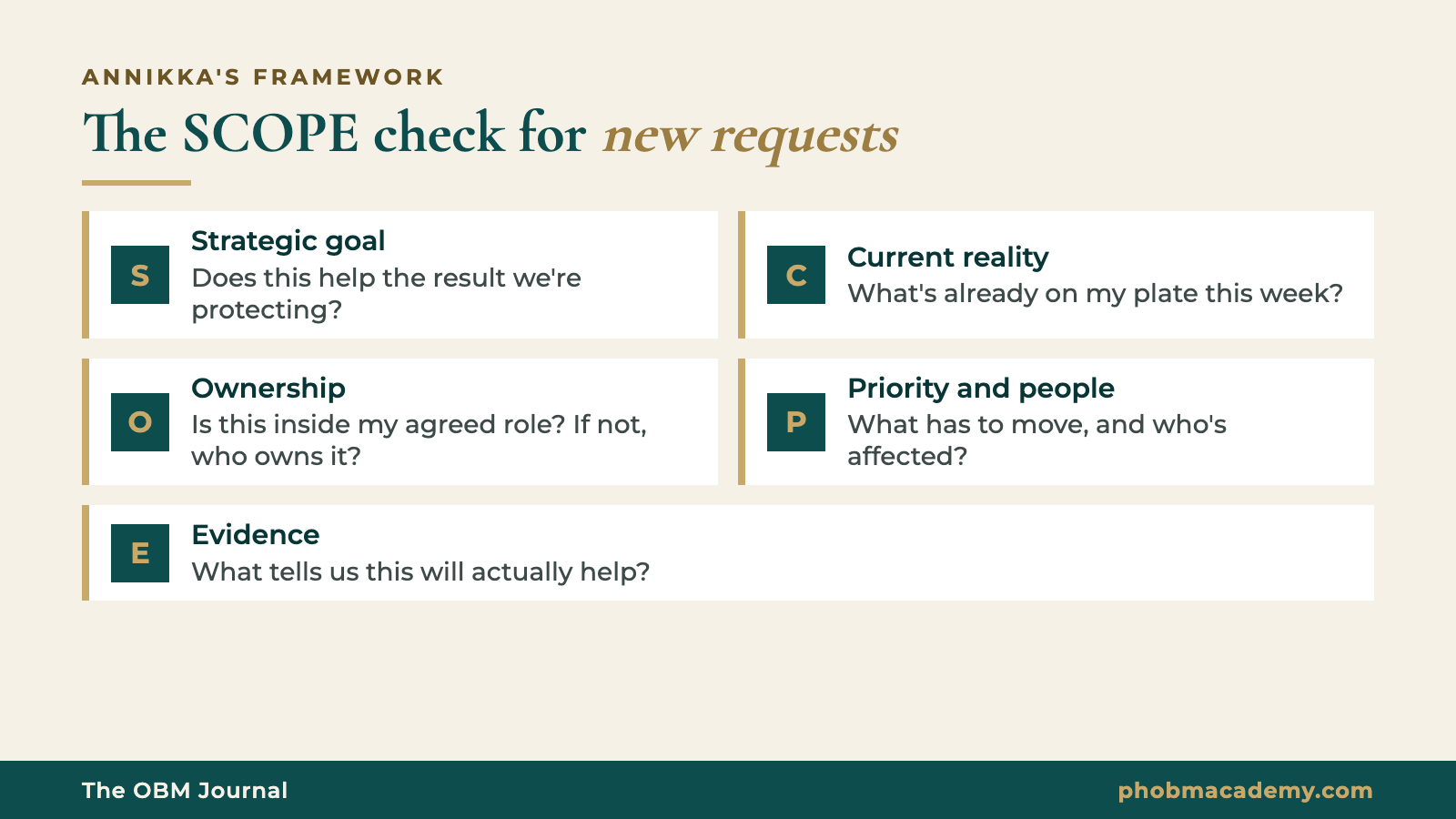
| Letter | Stands for | Ask yourself |
|---|---|---|
| S | Strategic goal | What result are we protecting right now, and does this request help it? |
| C | Current reality | What's actually on my plate this week, and what's the customer experiencing? |
| O | Ownership | Is this inside my agreed role? If not, who should own it? |
| P | Priority and people | What would have to move if I take this on, and who's affected? |
| E | Evidence | What tells us this will actually help, beyond "it would be nice"? |
The rule behind SCOPE: don't prescribe a new tool, a new task or a new hire before you understand the business problem. Sometimes the request is the right call and it should be in your scope. SCOPE just makes sure you both choose it on purpose.
How to handle scope creep: what do I say when a client asks for more?
Say yes to the goal, then give options for the request. Don't argue about whether it's "your job." Show what it costs and let the client choose.
Here are three common versions, with the kind of reply a VA would actually type.
1. The small one-time favor
Client
omg can you resize these 4 graphics for stories real quick? 🙏 need them before my live
You
On it! Will send in 20 👍
Yes, just do it. Small one-off favors are part of a good working relationship. The only thing to watch is the pattern. Jot it down in your notes or tracker. If "real quick" shows up three times a week, it's not a favor anymore, it's a new task, and it goes in your next weekly update.
2. The new recurring responsibility
Client
hey can you also handle my IG DMs from now on? shouldn't take long 😅
You
Happy to help with DMs! Quick check so nothing else slips: right now my week is the launch emails and the onboarding cleanup. If I add DMs every day, something has to move. A few options:
- I take DMs and we push the onboarding cleanup to next week
- We add DMs as extra hours this month and I keep everything else on track
- I set up saved replies so DMs are faster, and we look at how much time it takes after 2 weeks
I'd go with 3, so we know the real time before we commit. Which works for you?
This is the reply most VAs never send. It's friendly, it's fast, and it gives the client a real choice. Notice it uses the same structure as a good client update: where things stand, options, a recommendation and a clear question. I break that structure down in how to write a client update that gets a decision.
3. The role-sized expansion
Client
ok random idea but what if you ran the whole podcast?? guest booking, editing, show notes, all of it 🎙️✨
You
I love that you thought of me for this! Running the podcast is a bigger role than what I do now, so before I say yes, can we do a quick call this week? I'd like us to agree on what "running it" covers, what I'd decide on my own, how many hours it needs, and how we update my scope and fee. I'll bring a short draft so it's easy 😊
This is the boundary rule in action. Result, scope, authority, time and compensation, agreed before you start. You're not saying no. You're making sure the yes is real.
Another freelancer on Reddit did a version of this. When the agency asked for two extra projects after her retainer ended, she offered to finish leftover revisions on work already started, but said she wouldn't take on new projects without a separate paid arrangement (Reddit, Sep 25, 2026). That's an option, not a door slammed shut.
Should I ever do extra work for free?
Yes, sometimes, as long as you decide it on purpose and you say so. A one-time favor during a crunch can build a lot of goodwill.
What doesn't work is free work that quietly becomes part of the job. Some simple habits keep it visible:
- Keep a running list of extra requests and how long they took.
- Mention them in your weekly update, even if you didn't charge for them.
- If something becomes regular, bring it up as a scope conversation, not a complaint.
People in the comments of a June 2026 YouTube video about leaving a VA client (older than our usual 90-day window) shared similar habits: follow up any phone agreement with an email that confirms it, and when a client adds work, send a revised contract that reflects it (YouTube, life and numbers, June 2026).
How do I stop scope creep before it starts?
You stop most scope creep by writing the scope down where both of you can see it, then checking it out loud on a schedule.
Here's the simple version I'd set up with any client:
- Write a one-page scope. What you own, what you don't, how fast you reply, and who decides what.
- Send a recap after every kickoff or big call. "Here's what we agreed" in five bullets.
- Add one scope line to your weekly update. "This week I also handled X and Y (outside our usual scope)."
- Review the scope once a month. Ask: is this still the right job? What should come off the list?
- Use the boundary rule for anything role-sized. Result, scope, authority, time and compensation first.
That monthly review is where good clients actually upgrade your role. When you can show the extra work and the results it produced, the conversation about a bigger scope (and a better fee) is much easier. If you're not sure you're ready to run a bigger role, check yourself against the 7 online business manager skills.
Frequently asked questions
What is scope creep for a virtual assistant?
Scope creep for a virtual assistant is when your tasks keep growing past what you were hired for, without anyone adjusting your hours, pay or priorities. It usually arrives as small requests like "can you also..." or "real quick," one message at a time. The problem isn't a bigger role. The problem is a bigger role that nobody agreed to on purpose.
How do I tell a client a task is out of scope?
Start by saying yes to the goal behind the request, then explain what's already on your plate and offer options. For example: take it on and push something else, add it with more hours, or park it for later. Recommend one option and ask the client to choose. This keeps the tone helpful instead of defensive, and the client stays in control.
Should I do extra tasks for free?
Occasionally, and only on purpose. A small one-time favor during a busy week builds goodwill. But track every extra request, mention it in your weekly update, and raise it as a scope conversation if it becomes regular. Free work that quietly turns into part of the job is how VAs end up doing manager-level work without the role or pay.
How do I say no to a client without losing them?
Don't say a flat no. Offer choices instead: swap the new request for something already on your list, add it with more time and pay, or move it to later. Most clients don't want to overload you. They just don't see your full workload. Showing them the trade-off, kindly and clearly, usually makes them trust you more, not less.
How do I bring up pay when my tasks keep growing?
Bring it up as a scope conversation, not a complaint. Show the extra work you've been handling, the results it produced, and what the role now looks like. Then propose updating the agreement: the result you own, the scope, your authority, the time it takes and your fee. Agreeing all five together makes it a business decision instead of a favor.
Your next step
Defining the work is one of the seven skills every OBM needs. Take the free OBM Readiness Scorecard to see where your skills stand, then join the free OBM community on Facebook and bring your trickiest "can you also..." message. We'll help you write the reply.
If you want to practice scope conversations on a realistic client engagement with feedback, take a look at OBM Pros, which starts December 2026.